The name on the front of a bottle of spirits isn't marketing: in Great Britain, words such as gin, rum, whisky and liqueur are legal categories, each with its own rules on strength and how the drink is made. This guide explains what the commonest ones mean, from the GOV.UK labelling guidance and the law it is based on. It covers Great Britain; Northern Ireland follows a slightly different set of rules.
What counts as a spirit drink?
GOV.UK defines a spirit drink as an alcoholic drink made from agricultural ingredients with a minimum strength of 15% ABV (egg liqueur, such as advocaat, is the exception at 14%). Great Britain has 47 categories. A bottle must show the name of the category it meets, such as 'rum'. A drink that is a spirit but fits none of the categories has to be called simply 'spirit drink'.
Minimum strengths and the main rules
These figures come from the category definitions in retained Regulation (EC) No 110/2008:
- Vodka: at least 37.5%.
- Gin: at least 37.5%, and the taste must be predominantly juniper.
- Distilled gin: at least 37.5%; made by redistilling spirit with juniper and other botanicals.
- London gin: at least 37.5% (see below).
- Rum: at least 37.5%. It can't be flavoured; caramel may be added only to adjust the colour.
- Whisky or whiskey: at least 40%, matured for at least three years in wooden casks of no more than 700 litres. It can't be sweetened or flavoured; plain caramel is the only colouring allowed.
- Brandy: at least 36%, aged for at least a year in oak (or six months in oak casks of under 1,000 litres).
- Liqueur: at least 15%, with a minimum sugar content — generally 100 g per litre.
- Egg liqueur or advocaat: at least 14%, with at least 150 g of sugar or honey per litre.
The strength on the label is the ABV — the percentage of the drink that is alcohol.
'London gin' and 'dry gin'
London gin is a method, not a place. The rules say all its flavour must come from redistilling the spirit with natural botanicals; after distillation nothing may be added except water and, at most, 0.1 g of sweetening per litre — and no colouring. A London gin can be made anywhere.
Dry on a gin or distilled gin means any added sweetening is no more than 0.1 g of sugar per litre. Flavoured and sweetened drinks that don't meet these rules have to be named differently. See our gin cocktails for ways to use a classic dry gin.
What makes a whisky Scotch?
The Scotch Whisky Regulations 2009 say Scotch Whisky must be:
- distilled at a distillery in Scotland, from water and malted barley (other whole cereal grains may be added);
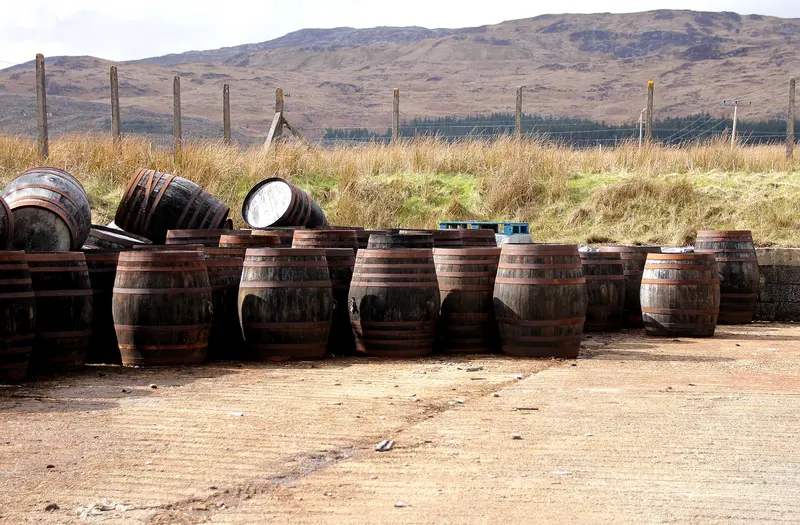
- matured only in Scotland, in oak casks of no more than 700 litres, for at least three years;
- bottled at at least 40%, with nothing added except water and plain caramel colouring.
The same regulations set five categories:
- Single Malt Scotch Whisky — from one distillery, made only from water and malted barley, distilled in pot stills.
- Single Grain Scotch Whisky — from one distillery, but not a single malt or a blend.
- Blended Malt Scotch Whisky — single malts from more than one distillery, blended.
- Blended Grain Scotch Whisky — single grains from more than one distillery, blended.
- Blended Scotch Whisky — single malt blended with single grain.
Age statements: if a label gives an age, it must be in years and refer to the youngest whisky in the bottle. A '12 year old' blend can contain older whisky, but none younger than 12 years. Scotch Whisky is also a protected geographical name, as is Irish Cream, which must be made on the island of Ireland.
Browse our whisky drinks, from the Old Fashioned to the whisky highball.
Why it's 'spiced rum' and not just 'rum'
Because rum can't be flavoured under its own definition, a flavoured rum has to use a compound term, such as 'spiced rum', which joins the spirit's name to the food that flavours it. GOV.UK says:
- the words must be in the same font, size and colour, with nothing in between;
- in Great Britain, all the alcohol must come from the named spirit;
- a compound term can't be used if the spirit has simply been watered down below its minimum strength.
So a gin that has simply been watered down below 37.5% can't be sold as gin with another word added.
Alcohol-free 'spirits'
GOV.UK says names such as 'alcohol free rum', 'low alcohol gin' or 'gin alternative' are not permitted, because a drink without the alcohol can't meet the spirit's definition. Our guide to alcohol-free and low-alcohol drinks explains what the descriptors on those bottles mean.
Strength and units
Spirits are strong, so measures matter. The NHS says a single 25 ml measure of a 40% spirit is 1 unit, and a large 35 ml single is 1.4 units. A pub double is twice that. The formula for any drink is ABV × ml ÷ 1,000 = units.
Sources
- GOV.UK (Defra) — Labelling spirit drinks (updated 25 July 2025)
- legislation.gov.uk — Regulation (EC) No 110/2008, Annex II: spirit drink categories (revised)
- legislation.gov.uk — Scotch Whisky Regulations 2009, regulation 3: definition and categories
- legislation.gov.uk — Scotch Whisky Regulations 2009, regulation 12: age statements
- NHS — Alcohol units
Checked when this entry was written. Links open the original source in a new tab.